Avalanche warning levels range from 1 (low) to 5 (very high) and have been uniformly applied throughout the Alpine region since 1993. They provide an at-a-glance overview of the condition of the snowpack and, consequently, the safety of traveling in open terrain.
Who is this article for?
For anyone who hikes or snowshoes in the winter. You can find hiking hotels with the relevant expertise at Winter Hiking Pure or Snowshoeing.
Respect for the mountains
The good news: With a little basic knowledge, a quick look at the avalanche report, and some on-site advice, you’ll be perfectly prepared. We’ll show you how to do it—without fear, but with respect for the mountains.
At a hiking hotel, you’ll get the best advice
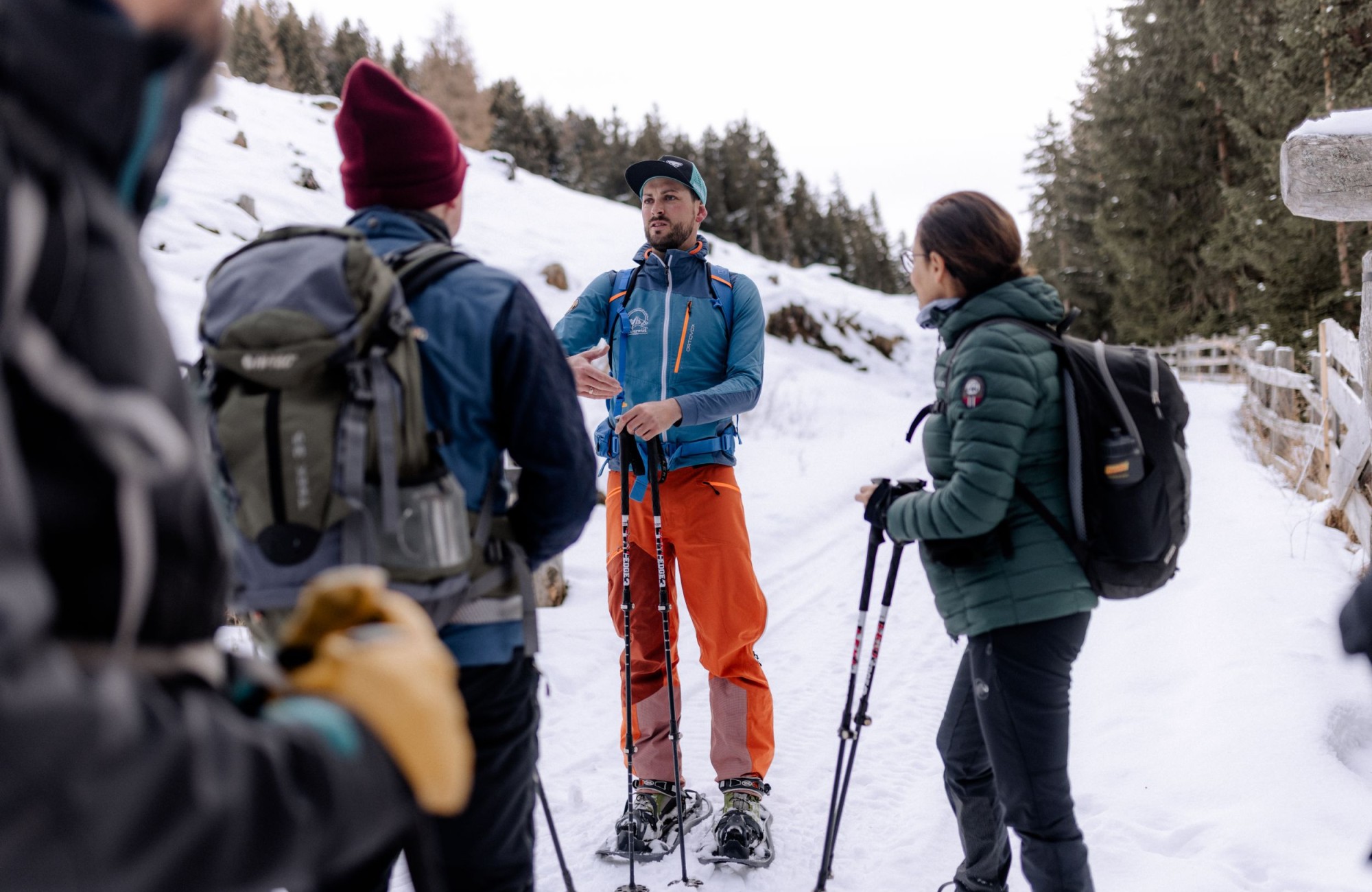
You don’t have to figure out the avalanche report and map on your own. Every hiking hotel offers guided tours led by certified hiking guides. They know the mountains, the trails, and the current snow conditions, and can provide expert advice on all questions regarding avalanche danger, accessible trails, and suitable tours. They also know where to find the most beautiful spots in any situation: in the forest, on sunny slopes, and on the winter hiking trails in the valley.
TIP FROM THE WANDERHOTELS: Ask the night before which trails will be in good condition tomorrow. By breakfast, you’ll have your hike all planned out, and the rest is pure enjoyment.
Unfortunately, you're not always staying at a Wanderhotel. That's why we're showing you here how to read avalanche reports on your own, where to find reliable information, and what to do in an emergency.
Key Points at a Glance
The European Avalanche Danger Scale has five levels: 1 low, 2 moderate, 3 considerable, 4 high, 5 very high
The levels are not arranged in equal increments: Level 3 is not simply “one more” than Level 2, but indicates a significantly greater increase in danger than the number would suggest.
A level describes an entire region of at least 100 km², not a single slope
Avalanches can be triggered on slopes with an incline of about 30 degrees or more
When venturing off marked trails into open terrain, an avalanche transceiver, probe, and shovel—along with proper training in their use (completion of a course)—are standard equipment.
Every Wanderhotel offers guided winter hikes with trained hiking guides and expert advice on avalanche danger and accessible trails.
What does “open terrain” mean?
“Open terrain” refers to areas away from secured and marked trails and slopes. There, you must assess the avalanche danger yourself or be guided by a hiking guide. On secured winter hiking trails, you’re generally on the safe side. If in doubt, ask at your hotel whether the trail is open.
Our recommendation: If you have no experience with avalanche safety, stay on secured trails or hike with a guide starting at Level 3 (significant). At levels 1 and 2, beginners should stick to terrain with a slope of less than 30 degrees. According to the Alpine Club, anyone hiking in open terrain should carry an avalanche transceiver, probe, and shovel and be trained in their use—it’s not enough to watch a YouTube tutorial; you must complete a proper course. On a guided tour, your hiking guide will go over the equipment with you.
The descriptions are based on the European Avalanche Warning Scale used by avalanche warning services (source: EAWS) and are presented here in simple terms. “Additional load” refers, for example, to a person moving through the terrain. Especially when traveling as a group on snowshoes, you can minimize this additional load at specific points by maintaining a distance of at least 10 meters from one another.
The snowpack is firm and stable. An avalanche can only be triggered by a significant additional load and only in a few places on extremely steep terrain.
For you: generally safe conditions.
The snowpack is only moderately cohesive on some steep slopes; otherwise, it is well-consolidated. Avalanches can be triggered, especially under heavy additional loads, on the steep slopes mentioned in the report. Very large spontaneous avalanches are not expected.
For you: favorable conditions; keep an eye on steep slopes steeper than 30 degrees.
On many steep slopes, the snowpack is only moderately to weakly bonded. Even a slight additional load can trigger an avalanche there, and spontaneous avalanches are also possible.
Here’s what you need to know: For traditional snowshoers and winter hikers without in-depth avalanche knowledge, Level 3 in open terrain is a clear “stop” signal.
From the perspective of the Wanderhotels, the risk off-trail is simply too great right now, as even the slight additional weight of a single hiker can trigger an avalanche. Anyone who still wishes to undertake a tour in open terrain should join a professionally guided group. A trained mountain or hiking guide can expertly assess the avalanche conditions and choose a route with the lowest possible risk.
On most steep slopes, the snowpack is only weakly bonded. On numerous steep slopes, even a small additional load is likely to trigger an avalanche.
For you: touring options are severely limited. You should not venture into open, unsecured terrain. A walk in the valley is also nice!
The snowpack is generally weak and largely unstable. Spontaneous avalanches can be expected even on moderately steep terrain. This level is very rare.
For you: Backcountry touring is generally not possible; it’s a good day for the sauna and a tiled stove.
Why Level 3 Comes Up So Often
Level 3 is not an exception, but rather the norm in the Alps: According to the Institute for Snow and Avalanche Research (SLF), over the past ten years, Level 2 has been in effect on average nearly every other day, and Level 3 on average every third day. At the same time, according to the EAWS, about 50% of avalanche fatalities are attributable to Level 3. The reason: Conditions often appear inviting, but on many steep slopes, the snowpack is only moderately to weakly consolidated.
For you, this doesn’t mean “stay home,” but rather “plan carefully and seek advice.”
Avalanches can be triggered on slopes with an incline of about 30 degrees or more. Wet snow and gliding snow avalanches can also occur on less steep slopes, and avalanches can travel very far into flatter terrain (source: Alpine Club). This means: Don’t just look at the trail, but also at the slopes above your route.
THE DIGITAL TIP FROM THE WANDERHOTELS: When planning tours off the beaten path, apps designed solely for summer use reach their limits. The experts at the Hiking Hotels therefore recommend using tools such as Outdooractive, the SnowSafe app, or the regional apps from avalanche warning services. The reason: These winter specialists color-code slopes with a critical incline of 30 degrees or more on the map, which is essential for safely assessing avalanche conditions.
Emergency Call in the Alps
Austria: 140, Alpine Emergency Number of the Mountain Rescue Service
Europe-wide: 112, works regardless of your mobile network provider. If your phone displays "Emergency calls only," restart it and enter 112 instead of your PIN code! This will automatically connect you to the strongest available network.
South Tyrol / Italy: 112
No mobile network? Then use the Alpine distress signal: 6 times per minute – i.e., one signal every 10 seconds (shouting, whistling, or flashing a light). Pause for 1 minute. Repeat.
App tip: Install the SOS EU Alp app (Tyrol & South Tyrol) or the Notfall App Bergrettung (Austria) in advance. In an emergency, they transmit your exact GPS coordinates to the rescue dispatch center at the push of a button.
They describe how stable the snowpack is: 1—low, 2—moderate, 3—significant, 4—high, 5—very high. The scale has been in use throughout the Alpine region since 1993.
There is no single limit, as the danger depends on the terrain. Starting at Level 3, touring options in open terrain are limited, especially on slopes steeper than 30 degrees. If in doubt, choose a route in safe terrain or ask your Wanderhotels hiking concierge.
Usually daily starting with the first major snowfall; in Tyrol and South Tyrol, the evening before around 5 p.m.
"Unmarked terrain" refers to areas outside of secured and marked trails and slopes. There, you must assess the avalanche risk yourself or be guided by a hiking guide.







 Members Area
 Hiking Concierge
 Hiking Scout
 Our Team
 Podcasts & Press